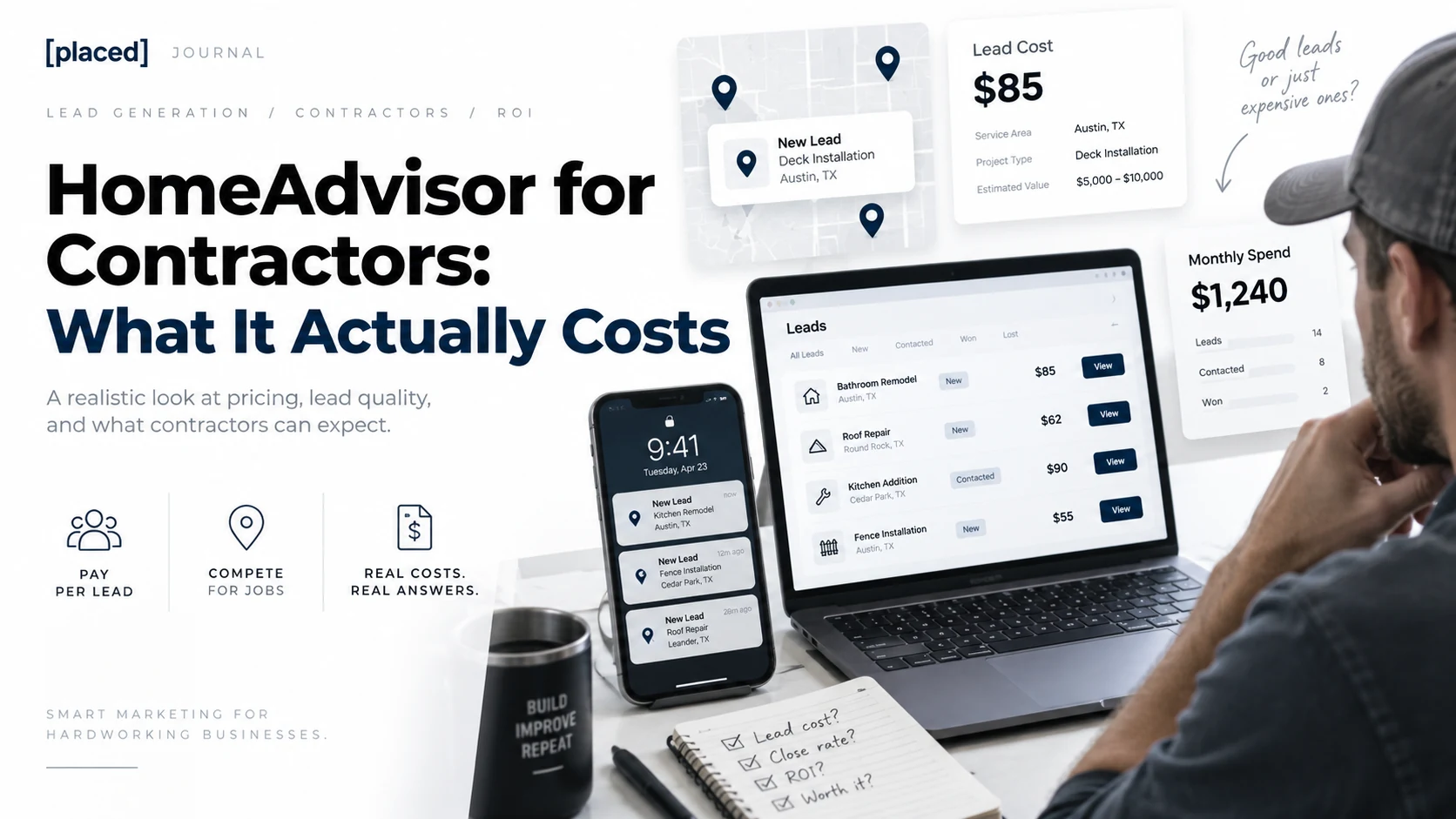
HomeAdvisor charges contractors an annual membership fee plus a separate fee for every lead it sends, and you pay that lead fee whether you win the job, lose the job, or never reach the homeowner at all. It is worth paying for when you have open days on the calendar and nothing else feeding the phone; it stops being worth paying for the month your own name starts showing up in the map pack for the work you do.
That is the whole argument. The details matter, though, because the way the money moves is not obvious from the sales call.
| Channel | You pay | What you own |
|---|---|---|
| HomeAdvisor | Membership + per lead | Nothing. Shared lead |
| Google LSA | Per lead | Nothing. Shared lead |
| Google Ads | Per click | The click, while paying |
| Business Profile | Time or SEO fee | The profile |
| Your website | Build + upkeep | All of it |
The short version. HomeAdvisor is rented demand. You are buying a homeowner’s phone number that three or four of your competitors are also buying, at the same moment, for the same job. That is a reasonable trade when you need work this week and have no other pipeline. It is a bad long-term plan, because the day you stop paying, the calls stop the same afternoon, and you have nothing left to show for the spend.
How does HomeAdvisor actually work for contractors?
HomeAdvisor is owned by Angi Inc., the same company that owns Angi (formerly Angie’s List); HomeAdvisor and Angie’s List merged in 2017 and the parent company took the Angi name in 2021. For a contractor, the model is straightforward:
- You apply, pass a background and licensing screen, and pay an annual membership to be listed.
- You set the trades you do and the area you cover.
- A homeowner fills out a form describing a job.
- That request is sold to contractors whose settings match — usually more than one.
- Your card is charged for the lead when it is delivered, not when you win the work.
The fifth step is the one that catches people. You are not buying a job. You are buying a chance to be one of the calls that homeowner is about to get, and the fee lands either way. Lead prices vary widely by trade, job size and market — a drain cleaning inquiry and a full roof replacement are not priced the same — so the only number worth trusting is the one in your own account settings.
Is HomeAdvisor legit, or is it a scam?
It is a legitimate, publicly traded business, and it does deliver real homeowners. It has also been penalized for how it sold those leads. In January 2023 the Federal Trade Commission ordered HomeAdvisor to pay up to $7.2 million and to stop making unsubstantiated claims about lead quality and conversion rates; the FTC approved the final order in April 2023. The FTC’s own description of the case notes that service providers were paying an annual membership fee of $287.99 plus per-lead charges, and that sales agents had told them the first month of an optional $59.99 software subscription was free with membership, when it was not.
That is a public, verifiable fact, and worth knowing before you sign. It is not a reason to write the company off. It is a reason to hold the sales pitch to the standard you would hold a supplier quoting you a price over the phone: get the numbers in writing, and check them against your own results after ninety days.
Before you cancel anything. If HomeAdvisor is your only source of calls, do not shut it off to fund something else. Run both, watch your cost per booked job for a full quarter, and let the numbers decide. Turning off the only tap you have because a marketing article annoyed you is how good contractors end up with an empty April.
Why do the same leads go to my competitors?
Because that is the product. A lead sold once earns one fee; the same lead sold to four contractors earns four. Nothing about that is hidden — it is the standard shared-lead model across the category — but it explains almost everything contractors complain about.
It explains why the homeowner sounds annoyed when you call: you are the third person to ring in ten minutes. It explains why speed beats craftsmanship on these leads. And it explains why your close rate on platform leads will always look worse than on a referral, even though you are the same company doing the same work.
There is a second effect that costs you more quietly. Platforms build profile pages for contractors, and those pages compete in Google for your own name and your own service terms. A homeowner searching for you specifically can land on a page that lists you next to four alternatives. You paid to be listed there, and then you paid again for the lead that page produced.
You can rent the phone call, or you can own the place the call comes from. Only one of those still works next year.
Placed — Vancouver, WA
How do I get more reviews on HomeAdvisor — and does it matter?
Reviews on a lead platform help you compete inside that platform, and only inside it. They do not follow you if you leave, they do not show up when someone searches your company name on Google, and they do not help you appear in the map pack. Google reviews do all three.
So the ranking is not close. If you have limited energy for chasing reviews — and every contractor does — spend it on your Google Business Profile first. Those reviews sit on an asset you control, and they influence whether you show up at all, not just how you look once someone is already staring at a list.
If you are not sure where you stand, look yourself up the way a homeowner would: your trade plus your city, incognito, and see who is in the top three. If a national lead platform is above you for work you do in your own town, that is the problem to solve.
HomeAdvisor sells you the same homeowner Google would have sent straight to your site. For contractors in Clark County and the Portland metro, our SEO in Vancouver WA service is how you stop paying the middleman.
When is paying per lead the right call?
There are real situations where a lead platform beats everything else, and pretending otherwise would be dishonest:
- You are brand new. No reviews, no history, no site. Search takes months to reward you. You need work now.
- You have sudden capacity. A crew came free, a big job cancelled, and you need to fill three weeks. Paid channels turn on today; search does not.
- You are testing a new trade or a new town. Buying a handful of leads is a cheap way to find out whether demand exists before you build anything.
- Your close rate is high. If you answer fast, quote fast, and win a solid share of shared leads, the math can work. Some contractors are simply better on the phone than average, and the platform does not price for that.
What all four have in common is that they are temporary. Paid leads are a bridge. The problem is that most contractors are still standing on the bridge five years later, paying more every year, with nothing built on the other side.
What replaces it?
The same demand, reached earlier. Every one of those homeowners typed something into Google before they landed on a lead form. The work is to be the result they find first.
In practice that means a Google Business Profile that is complete, categorized correctly and collecting reviews steadily, and a website with a real page for each service you sell and each town you serve rather than one page listing everything.
Be honest about the clock. Profile and map movement often shows up in two to three months. Organic rankings for competitive service terms usually take six to twelve. That is slower than a lead platform, which is exactly why you run both during the overlap.
At Placed, ongoing local SEO starts at $800 a month and includes upkeep on your website; where a site needs rebuilding before it can rank or convert, that build starts at $2,500. What that price does not buy: Google Ads management, call tracking, unlimited content, or any guarantee about position. Anyone quoting you a guaranteed number-one ranking is quoting you something nobody can sell. More on how those numbers compare across the market in our breakdown of what contractors actually pay for SEO.
We work mostly with home service companies around Vancouver and Clark County — plumbers, HVAC, roofers — and the pattern holds. The contractor outranking you is rarely better at the work. He is just easier to find.
Frequently asked questions
How much does HomeAdvisor cost for contractors?
You pay an annual membership fee to be listed, plus a separate fee each time a lead is delivered to you. Lead fees vary considerably by trade, job size and market, so the reliable figure is the one shown in your own account rather than any number quoted in an article. The FTC’s 2023 case against the company described an annual membership of $287.99 at that time, plus per-lead charges.
Are HomeAdvisor leads shared with other contractors?
Usually, yes. The standard model sends the same homeowner request to multiple matching contractors, and each of them is charged for it. That is why response speed matters so much on these leads and why close rates run lower than on referrals.
Is HomeAdvisor a scam?
No — it is a real marketplace owned by Angi Inc. that does deliver genuine homeowner inquiries. It has, however, been subject to an FTC order requiring it to pay up to $7.2 million and to stop making unsubstantiated claims about lead quality and conversion rates. Read the terms carefully and judge it on your own booked-job numbers after a quarter.
What is the difference between HomeAdvisor and Angi?
They are sister brands under the same parent company, Angi Inc. HomeAdvisor and Angie’s List merged in 2017, and the parent took the Angi name in 2021. For contractors, both operate on a pay-for-leads basis rather than selling you exclusive work.
Should I cancel HomeAdvisor and do SEO instead?
Not on day one. Search results take time — often two to three months for profile and map movement and six to twelve for competitive organic terms — so cutting your only lead source before the replacement is producing leaves a gap. Run both, track cost per booked job for each, and let that number decide when to scale one down.
Do HomeAdvisor reviews help me rank on Google?
No. Reviews on a lead platform help you compete within that platform only. Google reviews affect whether you appear in the local map pack and are visible to anyone searching your company or your trade, which is why they are the better place to spend your review-asking effort.